


Page 53 - Sports Energy News, Cornwall, Issue No 133
P. 53
www.sportsenergynews.com                                                         Issue #133 February 2024                                 53


      Continuing from page 32
                                                                                     KARATE KOMMENTS


                                                                                       By Jim Riddell,

                                                                                       Seaway Karate Club


                                                                                                       The Attributes: Speed
                                                                                         ver the eleven plus years that Karate Komments has been appearing
                                                                                    Oin Sports Energy, I have often mentioned the term “attributes” when
                                                                                    referring to things’ karate related.  The attributes  are the skill-related
                                                                                    components that are required to be proficient at a specified sport. During
                                                                                    the first year or two of karate training a student learns many of the basics
                                                                                    such as kicks, punches, strikes, self-defense, etc., and the improvement will
                                                                                    have been considerable. After that time the student will continue to develop,
                                                                                    learning new katas, more techniques, and expand into specialty training,
                                                                                    but to physically improve, each of the attributes will have to be targeted
                                                                                    separately.
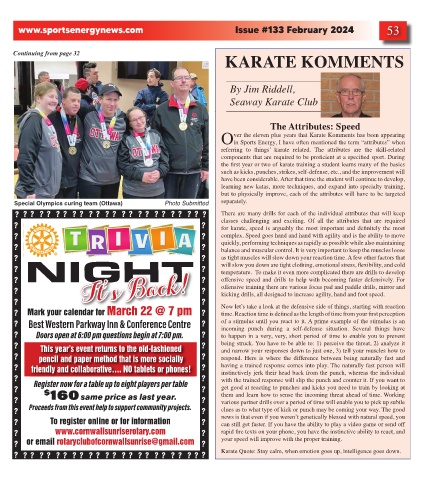
      Special Olympics curing team (Ottawa)                    Photo Submitted
       ?   ?  ?   ?  ?   ?  ?   ?  ?   ?  ?   ?  ?   ?  ?   ?  ?   ?  ?   ?  ?   ?  ?  ?   There are many drills for each of the individual attributes that will keep
                                                                                    classes challenging  and exciting.  Of all  the  attributes  that  are  required
      ?                                                                      ?      for karate, speed is arguably the most important and definitely the most
      ?                                                                      ?      complex. Speed goes hand and hand with agility and is the ability to move
                                                                                    quickly, performing techniques as rapidly as possible while also maintaining
      ?                                                                      ?      balance and muscular control. It is very important to keep the muscles loose
           NIGHT
      ?                                                                      ?      as tight muscles will slow down your reaction time. A few other factors that
      ?    NIGHT                                                             ?      will slow you down are tight clothing, emotional stress, flexibility, and cold
                                                                                    temperature.  To make it even more complicated there are drills to develop
                                It’s Back!
      ?                                                                      ?      offensive speed and drills to help with becoming faster defensively. For
      ?                         It’s Back!                                   ?      offensive training there are various focus pad and paddle drills, mirror and
                                                                                    kicking drills, all designed to increase agility, hand and foot speed.
      ?                                                                      ?      Now let’s take a look at the defensive side of things, starting with reaction
                                         March 22 @ 7 pm
      ?    Mark your calendar for March 22 @ 7 pm                            ?      time. Reaction time is defined as the length of time from your first perception

      ?
                             ?      of a stimulus until you react to it. A prime example of the stimulus is an
                                                                                    incoming punch during a self-defense situation.  Several things have
      ?
                           ?      to happen in a very, very, short period of time to enable you to prevent

      ?         This year’s event returns to the old-fashioned               ?      being struck. You have to be able to: 1) perceive the threat, 2) analyze it
      ?         pencil and paper method that is more socially                ?      and narrow your responses down to just one, 3) tell your muscles how to
                                                                                    respond. Here is where the difference between being naturally  fast and
      ?      friendly and collaborative…. NO tablets or phones!              ?      having a trained response comes into play. The naturally fast person will

      ?


                             ?      instinctively jerk their head back from the punch, whereas the individual
                                                                                    with the trained response will slip the punch and counter it. If you want to
      ?                                                                      ?      get good at reacting to punches and kicks you need to train by looking at

      ?                                                                      ?      them and learn how to sense the incoming threat ahead of time. Working
                                                                                    various partner drills over a period of time will enable you to pick up subtle
      ?                                                                     ?      clues as to what type of kick or punch may be coming your way. The good

      ?             To register online or for information                    ?      news is that even if you weren’t genetically blessed with natural speed, you
                                                                                    can still get faster. If you have the ability to play a video game or send off
      ?               www.cornwallsunriserotary.com                          ?      rapid fire texts on your phone, you have the instinctive ability to react, and

      ?    or email rotaryclubofcornwallsunrise@gmail.com                    ?      your speed will improve with the proper training.

      ?  ?  ?   ?  ?   ?  ?   ?  ?   ?  ?   ?  ?   ?  ?   ?  ?   ?  ?   ?  ?   ?  ?   ?  Karate Quote: Stay calm, when emotion goes up, intelligence goes down.

